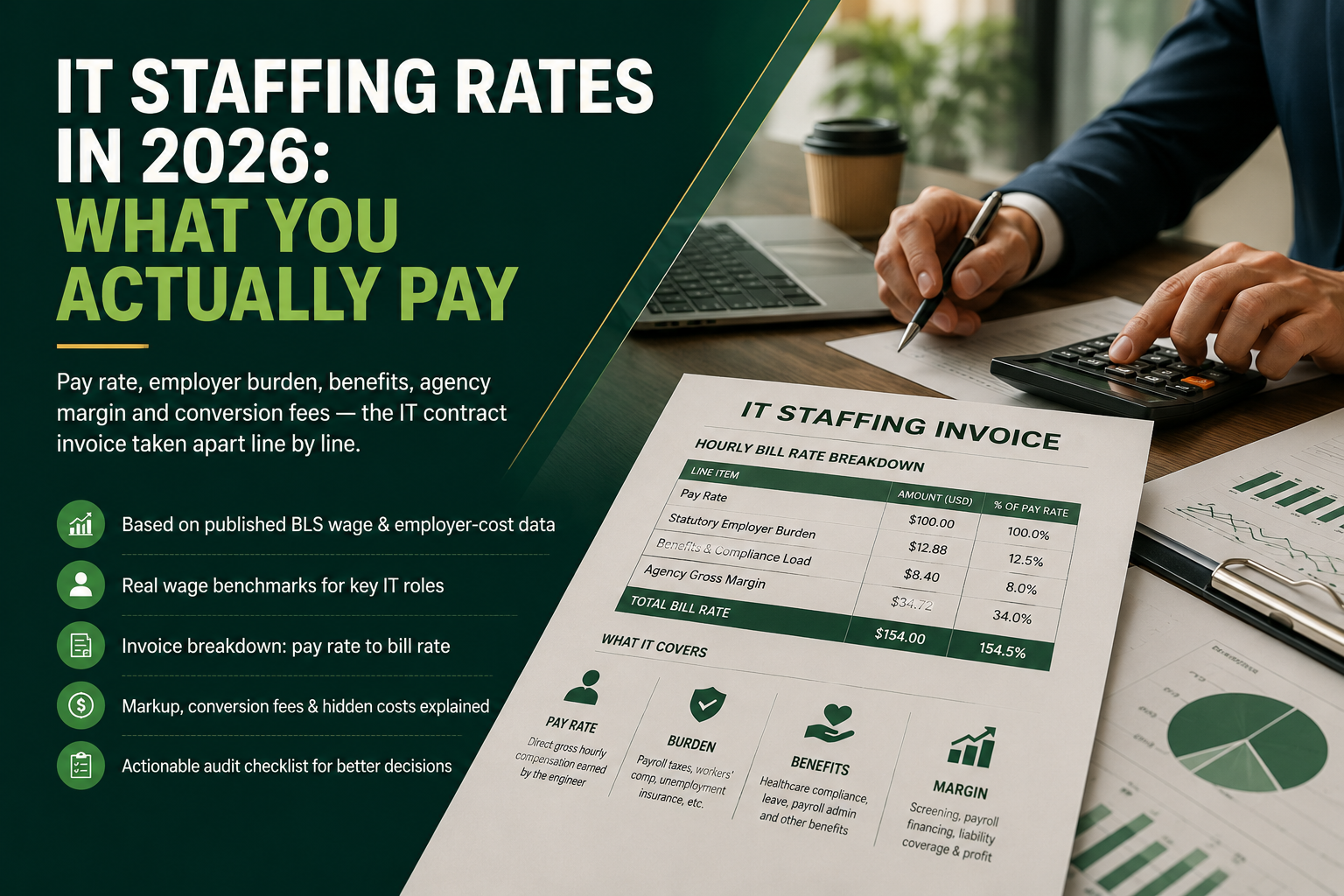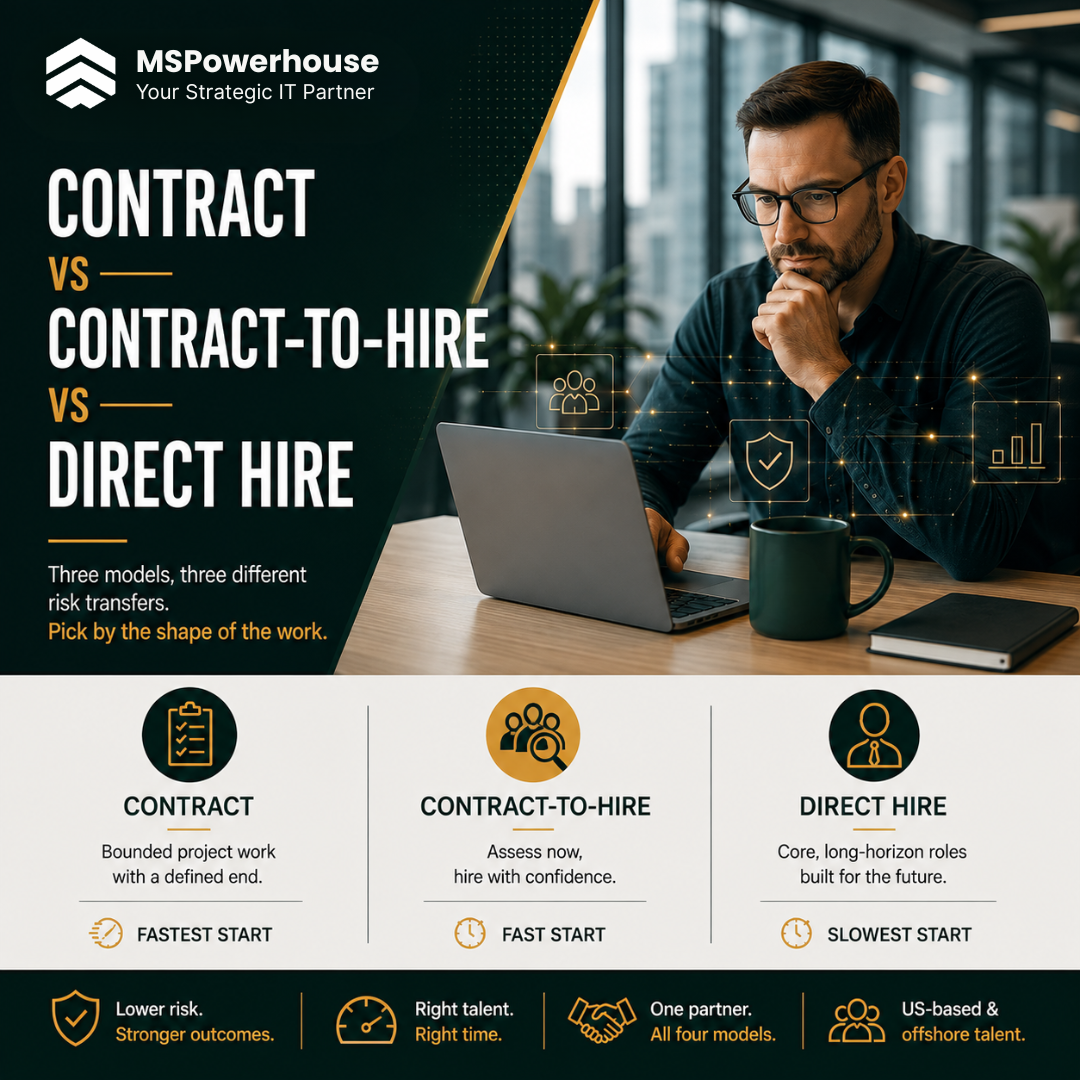

Contract-to-hire is sold as risk reduction. Whether it is actually cheaper depends on two variables: how long the engineer remains on contract, and how the conversion fee is structured. Here is the 24-month financial math, factoring in the loaded employer costs most comparisons leave out.
What you are actually buying
In contract-to-hire, the staffing agency operates as the legal W-2 Employer of Record (EOR) for an agreed trial window (typically 3 to 6 months). The agency carries payroll cash-flow, statutory taxes, workers' compensation, and benefits liability. In exchange, you pay an hourly premium over the engineer's base wage for the contractual option to evaluate technical depth in production and walk away without severance or unemployment liability if the fit is wrong.
The costs both sides carry
A direct-hire salary is never the true cost of an employee. According to the BLS Employer Costs for Employee Compensation (ECEC) release, non-wage benefits and statutory obligations account for 30.1% of total employer compensation cost for private industry workers (against 69.9% for wages). Mandatory employer FICA alone is 7.65%, plus federal and state unemployment (FUTA/SUTA) and workers' comp. Every staffing decision must be modeled against fully loaded cost, not the offer letter.
| Cost Category | Direct Hire | Contract-to-Hire | Dedicated Staffing Model |
|---|---|---|---|
| Base Compensation | You pay salary directly | Embedded in hourly bill rate | Fixed monthly flat fee |
| Taxes & Benefits Burden | You carry ~30% on top of salary | Agency carries during trial | Provider carries 100% of burden |
| Upfront Sourcing Fee | 15% to 25% placement fee or internal recruiting time | No upfront fee (paid via hourly margin) | Zero upfront fee |
| Wrong-Hire Penalty | Severance, UI claims, €“ to restart search | End assignment with 1–2 weeks notice; replacement included | Replacement included; cancel month-to-month |
| Conversion Mechanics | None (already direct employee) | Flat fee OR decaying buyout schedule | Retain as dedicated managed capacity |
The 24-month financial comparison
To evaluate the crossover point where contract-to-hire shifts from a risk mitigation tool into an expensive markup, let's model a Systems Administrator (,800 BLS national median salary / /hr pay rate) across 24 months:
| Timeline Stage | Direct Hire (.8K Base + 30% Burden) | Contract-to-Hire (/hr Bill Rate) | Dedicated Professional (,999/mo Onshore / ,499/mo Offshore) |
|---|---|---|---|
| Months 0 to 3 | ~,500 (Sourcing costs, internal interview hours, salary ramp) | ~,200 (/hr × 520 hrs; zero upfront fee, live output from week one) | ,497 (Offshore) / ,997 (Onshore) (Fixed cost, active immediately) |
| Months 3 to 6 | ~,460 (Standard loaded salary at ,486/mo) | ~,200 (Trial continues; zero exit liability if performance fails) | ,497 (Offshore) / ,997 (Onshore) (Flexible month-to-month) |
| Months 6 to 12 | ~,920 (Lowest monthly run-rate if candidate succeeds) |
~,920 (Converted at Month 6 with decaying buyout)
OR ,400 if left on contract |
,994 (Offshore) / ,994 (Onshore) (Predictable fixed overhead) |
| Months 12 to 24 | ~,840 (Most cost-effective long-term structure if retained) |
~,840 (Converted run-rate)
OR ,800 if left on contract |
,988 (Offshore) / ,988 (Onshore) (Cheapest model when permanent headcount is frozen) |
The Crossover Takeaway
Contract-to-hire delivers maximum economic value during the first 6 months (720 to 1,040 hours). During this trial, the ,000–,000 billing premium is offset by eliminating the financial risk of a bad direct hire. However, if you fail to convert at month 6 and leave the contractor on an hourly bill rate through month 24, you will pay over ,000 in unnecessary agency margin.
Conversion fees: get the structure right
Agencies structure conversions in two ways:
Flat Percentage Buyout: A rigid 15% to 25% fee based on the candidate's first-year salary regardless of how many months they have been billed. Avoid this structure.
Decaying Buyout Schedule: The conversion fee reduces proportionally with every billed hour worked until reaching zero—typically at 720 to 1,040 billed hours (4 to 6 months).
The decaying schedule is strictly superior for employers. It recognizes that the agency has already recovered its recruitment costs through the hourly billing margin. Critical operational rule: lock the decaying conversion schedule into your master agreement on day one, never at the moment you decide to extend the full-time offer.
The MSPowerhouse take
Use contract-to-hire when role scope is evolving, headcount approvals are contingent on upcoming quarters, or internal leadership cannot reliably vet specialized Microsoft cloud skills. Pair it with a guaranteed decaying buyout from day one.
Classification and compliance thresholds
Two regulatory standards govern contingent IT engagements:
IRS Common-Law Control Test: If your team directs how, when, and with what tools the work is performed, the worker is an employee. Operating through a W-2 agency Employer of Record satisfies the IRS common-law control test and insulates your company from misclassification penalties.
ACA 30-Hour Threshold: Contingent workers averaging 30+ hours/week or 130+ hours/month are full-time for employer shared responsibility purposes (IRS ACA Guidance). Your staffing partner must carry this healthcare compliance obligation.
Decide in four questions
Is the role funded and clearly defined past 12 months? If yes → Direct Hire.
Is technical depth unproven or role scope fluid? If yes → Contract-to-Hire.
Does the conversion fee decay to within 6 months (1,040 hours)? If no → Renegotiate terms.
Is the primary requirement ongoing coverage rather than internal headcount? If yes → Managed IT Services.
Buying coverage vs. hiring headcount: If your workload consists of recurring systems administration, helpdesk ticketing, or 24/7 security monitoring, staffing a single individual creates coverage gaps and single-point-of-failure risk. Transitioning to Managed IT Services or Helpdesk Support provides team-wide coverage at a lower total monthly commitment.
How MSPowerhouse works
Every delivery model, technical screening by engineers, zero upfront fee
We provide contract, contract-to-hire, direct placement, and dedicated technical teams with complete fee transparency:
Candidates in 5 to 7 days: Fast shortlist turnaround on defined Microsoft 365, Azure, security, and infrastructure roles.
Screened by active IT engineers: Our practicing engineers evaluate real technical capability, not keyword algorithms.
No upfront fee: Review technical shortlists before committing capital.
Decaying conversion buyouts: Transparent schedules that decay to zero as hours are worked.
Replacement support included: If a candidate is not the right fit, we replace them without restarting the search fee.
Full EOR compliance: Payroll funding, statutory taxes, workers' comp, and benefits sit entirely with us.
Our dedicated staffing rates start at ,499/month for offshore talent and ,999/month for onshore US-based talent, with full employer-of-record administration included. Compare models on our IT staffing page or review client outcomes in our case studies.
Get your candidate shortlist
Tell us how long the role is funded for and the technical skills you need. We will recommend the right model and deliver an engineer-screened shortlist in 5 to 7 days.
(202) 963-1014