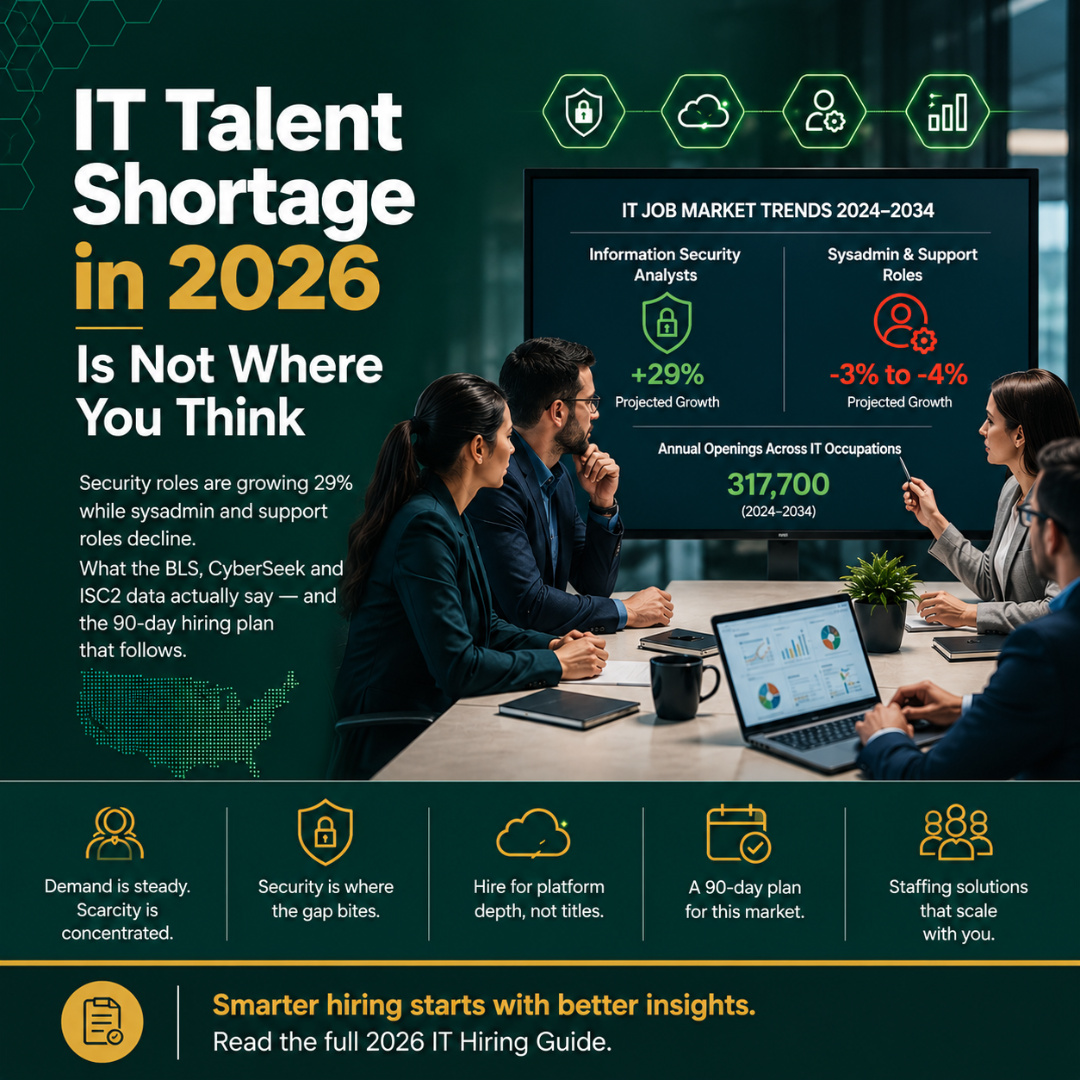
Security roles are growing 29% while traditional systems administration and support roles face slower or declining employment. What the latest BLS, CyberSeek and ISC2 data actually says about the US IT labor market — and the 90-day hiring plan employers should use in response.
“IT talent shortage” is too broad to act on.
The US still has strong demand for technology professionals, but the demand is not evenly distributed. The real hiring pressure is concentrated in specialized skills, particularly cybersecurity, cloud infrastructure, networking, data and modern Microsoft environments.
For employers hiring in 2026, that distinction matters. The challenge is not simply finding more candidates. It is finding candidates with the right technical depth, experience and availability.
Demand is steady. Scarcity is concentrated.
Employment in computer and information technology occupations is projected to grow much faster than the average for all occupations from 2024 to 2034. The U.S. Bureau of Labor Statistics projects approximately 317,700 openings each year, driven by both employment growth and the need to replace workers who leave the field. The median annual wage across the group was $105,990 in 2024, compared with $49,500 for all occupations. (bls.gov)
But the headline number hides an important split.
Some traditional IT roles are experiencing slower growth or decline as organizations adopt cloud platforms, automation and more consolidated technology environments. Meanwhile, demand continues to rise for specialized roles that require deeper experience.
| Role | 2024 Median Pay | 2024–34 Outlook | What It Signals |
|---|---|---|---|
| Computer Support Specialists | $61,550 | -3% | Automation and changing support models |
| Network & Computer Systems Administrators | $96,800 | -4% | Increasing automation and platform consolidation |
| Computer Systems Analysts | $103,790 | +9% | Broad, steady demand |
| Information Security Analysts | $124,910 | +29% | Acute demand for security expertise |
| Computer Network Architects | $130,390 | +12% | Continued need for senior infrastructure skills |
| Software Developers, QA Analysts & Testers | $131,450 | +15% | Strong demand for development and engineering talent |
Source: U.S. Bureau of Labor Statistics, 2024 median pay and 2024–34 employment projections. (bls.gov)
The takeaway is not that traditional IT jobs are disappearing.
It is that the mix of skills employers need is changing.
For example, BLS projects network and computer systems administrator employment to decline 4% from 2024 to 2034, while information security analysts are projected to grow 29%. BLS also notes that systems administrators are increasingly automating routine tasks. (bls.gov)
For organizations building technology teams, this creates a more specific problem:
The shortage is increasingly about specialization, not simply headcount.
Security is where the hiring gap is clearest
Cybersecurity provides one of the clearest examples.
CyberSeek counted 514,359 US employer job listings for cybersecurity positions during its May 2024 through April 2025 reporting period. About 10% of those listings referenced AI skills, showing how quickly the requirements for security roles are expanding. (cyberseek.org)
Demand is only part of the equation.
ISC2's 2025 Cybersecurity Workforce Study, based on 16,029 cybersecurity professionals, found that 33% of respondents said their organizations did not have the resources to adequately staff their security teams, while 29% said their organizations could not afford to hire people with the skills they needed. The study also found that 72% of respondents believe reducing cybersecurity headcount significantly increases breach risk. (isc2.org)
That creates a difficult hiring environment for US employers:
More specialized security work
More specialized security work
Higher expectations for hands-on experience
Higher expectations for hands-on experience
Competition for experienced professionals
Competition for experienced professionals
Limited internal recruiting capacity
Limited internal recruiting capacity
For a mid-sized company, competing directly with large enterprises for every experienced security professional is rarely a winning strategy.
The better question is how to access the skills required without turning every hard-to-fill role into a months-long search.
The same problem appears across cloud and Microsoft environments
Cybersecurity is not the only area where specialization matters.
Modern IT environments increasingly require professionals who can work across multiple interconnected technologies.
A company may advertise for a “Microsoft 365 Administrator,” but the actual work could involve:
Entra ID
Intune
Exchange Online
SharePoint
Teams
PowerShell
Identity and access management
Endpoint security
Compliance and governance
An “Azure Engineer” role may require experience across infrastructure, networking, identity, automation and migration.
A “Data Engineer” may need Azure Data Factory, Microsoft Fabric, SQL, ETL/ELT, data lakes and pipeline development.
This is why job titles alone are becoming less useful as a way to define technical hiring needs.
Hire for platform depth, not product titles
A narrow job title can attract a large number of candidates while still producing a weak shortlist.
Instead of asking:
“Do we need a SharePoint Administrator?”
Start with:
“What five things will this person need to own or deliver in the first 90 days?”
The answer might include migration work, permissions and governance, Microsoft 365 administration, automation and user support.
That changes the hiring process.
You are no longer looking for someone who simply lists SharePoint on a resume. You are looking for someone who has demonstrated the ability to perform the actual work.
For specialized IT roles, hiring teams should evaluate:
Technical environment
What platforms, systems and tools will the person work in?
Hands-on depth
Have they actually implemented, administered or troubleshot those technologies?
Scale
How large or complex were the environments they previously managed?
Problem-solving
What technical problems have they personally solved?
Business context
Can they communicate technical decisions to users, leadership and other teams?
This approach also makes staffing more effective because it gives recruiters a much clearer profile to source against.
Skills-based screening matters more as requirements become more specialized
Certifications can help establish baseline knowledge, but they do not always demonstrate practical ability.
The same resume can look equally strong for two very different candidates until you ask what they actually did.
Consider two candidates who both list:
Microsoft 365, Azure, Intune, Entra ID and PowerShell.
One may have administered a small tenant with limited responsibilities.
The other may have led a large migration, managed identity and endpoint policies, automated administrative work and supported a distributed workforce.
The keyword list is similar.
The technical value is not.
As specialization increases, employers need a hiring process that evaluates demonstrated experience rather than simply counting technologies and certifications.
Budget the full cost of an IT hire
Salary is also only part of the equation.
The BLS median annual wage for an information security analyst was $124,910 in 2024. Network architects had a median wage of $130,390, while software developers, QA analysts and testers had a median of $131,450. (bls.gov)
The employer cost is higher once benefits, recruiting time, equipment, onboarding, payroll costs and other employment expenses are included.
BLS's Employer Costs for Employee Compensation data has consistently shown benefits represent a substantial share of total employer compensation costs.
That matters when deciding how to fill a role.
A permanent employee may be the right answer.
But for a defined project, temporary skills gap or urgent workload increase, contract staffing can sometimes make more economic sense than creating permanent headcount immediately.
The staffing market is stabilizing, but specialized talent remains competitive
The broader US staffing market is not experiencing explosive growth.
Staffing Industry Analysts' March 2026 forecast projected the US staffing market to grow about 1% in 2026 to $180.2 billion, followed by approximately 2% growth in 2027. (thestaffingpulse.com)
That is a relatively modest market backdrop.
For employers, however, a slowly growing staffing market does not necessarily mean specialized IT talent is easier to find.
Experienced engineers with cloud, security, Microsoft, data and infrastructure skills are still valuable. The strongest candidates may already be employed and may never apply to a public job posting.
That is why sourcing depth matters.
An employer that relies entirely on job boards may be competing for the same visible candidates as every other company.
A staffing partner with an active technical talent network can reach a broader pool and narrow it based on the actual requirements of the role.
What this means for your 2026 hiring plan
Days 1–15: Define the work before the job title
Identify the five most important outcomes the person needs to deliver in the first 30–90 days.
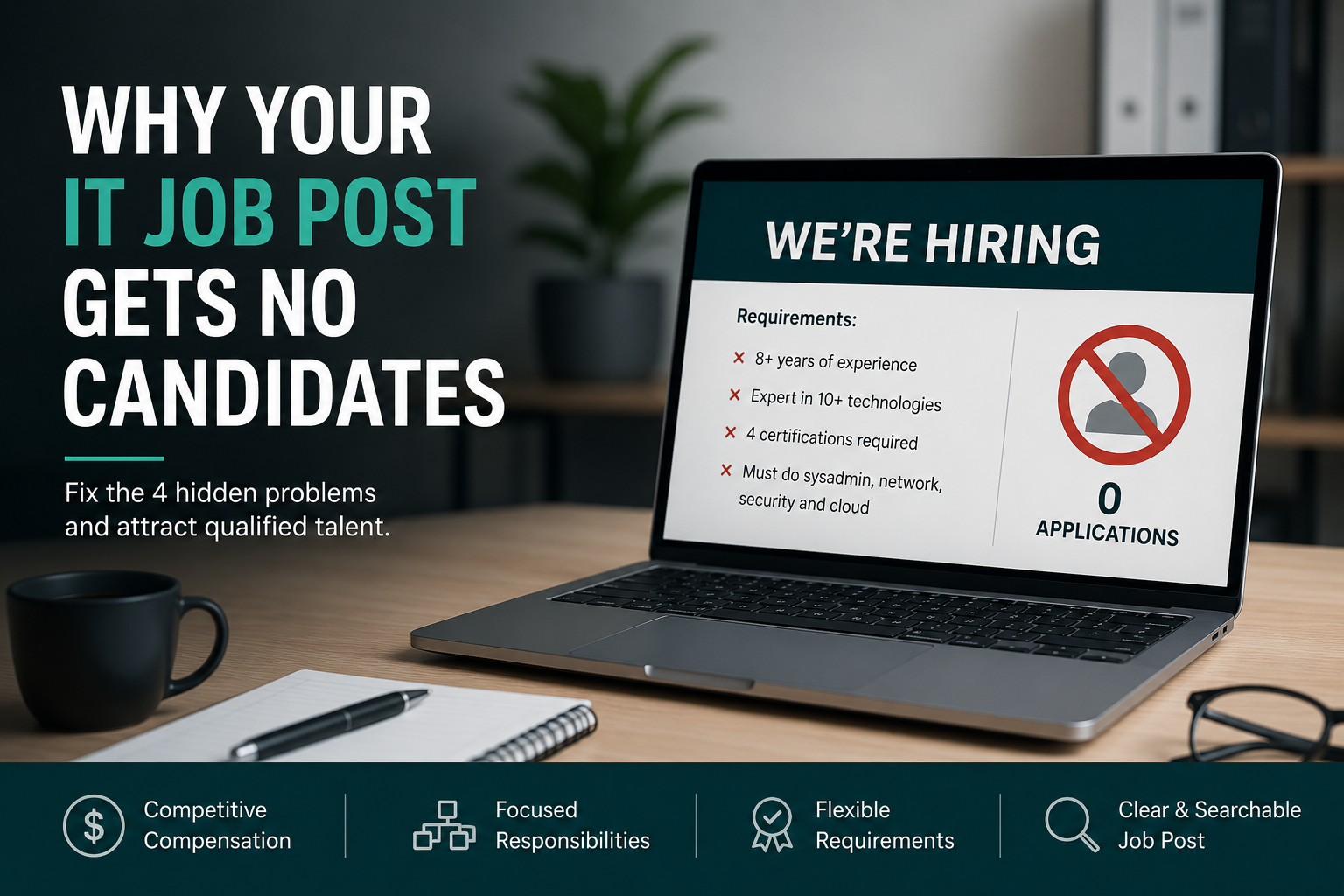
Separate genuine requirements from “nice to have” qualifications.
If the role requires Entra ID, Intune, Azure or cybersecurity experience, specify what the candidate must actually be able to do with those technologies.
Days 15–45: Screen for demonstrated technical ability
Use practical experience as a major screening criterion.
- Environments they managed
- Projects they delivered
- Technologies they implemented
- Incidents or technical problems they solved
- Automation they created
- Scale and complexity
- Security or compliance responsibilities
Certifications can support the evaluation. They should not replace it.
Days 45–75: Reconsider the staffing model
If the permanent search is taking longer than expected, consider whether contract or contract-to-hire could address the immediate need.
This can be particularly useful when:
- A project has a fixed deadline
- The team has an immediate skills gap
- Internal resources are overloaded
- The company wants to evaluate a candidate before making a permanent commitment
Days 75–90: Decide what the long-term team should look like
Once you have market feedback and candidate data, review the original requirement.
Ask:
- Is the workload permanent?
- Does the role need long-term internal ownership?
- Would a contract model be more appropriate?
- Is the compensation range competitive?
- Were the original technical requirements too broad?
- Did the candidate pool reveal that a different skill combination is actually needed?
The objective is not simply to close the requisition.
It is to build the technical capacity the business actually needs.
Contract, contract-to-hire or direct placement?
There is no single staffing model that works for every IT role.
Contract Staffing
Best suited for projects, temporary requirements, workload increases or immediate skills gaps.
It allows companies to add technical capacity without immediately adding permanent headcount.
Contract-to-Hire
Useful when an employer wants to evaluate a candidate in the actual working environment before making a permanent hiring decision.
It can reduce hiring risk while giving both sides time to assess technical and cultural fit.
Direct Placement
Best suited to permanent IT positions.
The staffing partner handles sourcing and screening while the employer hires the selected candidate directly into the organization.
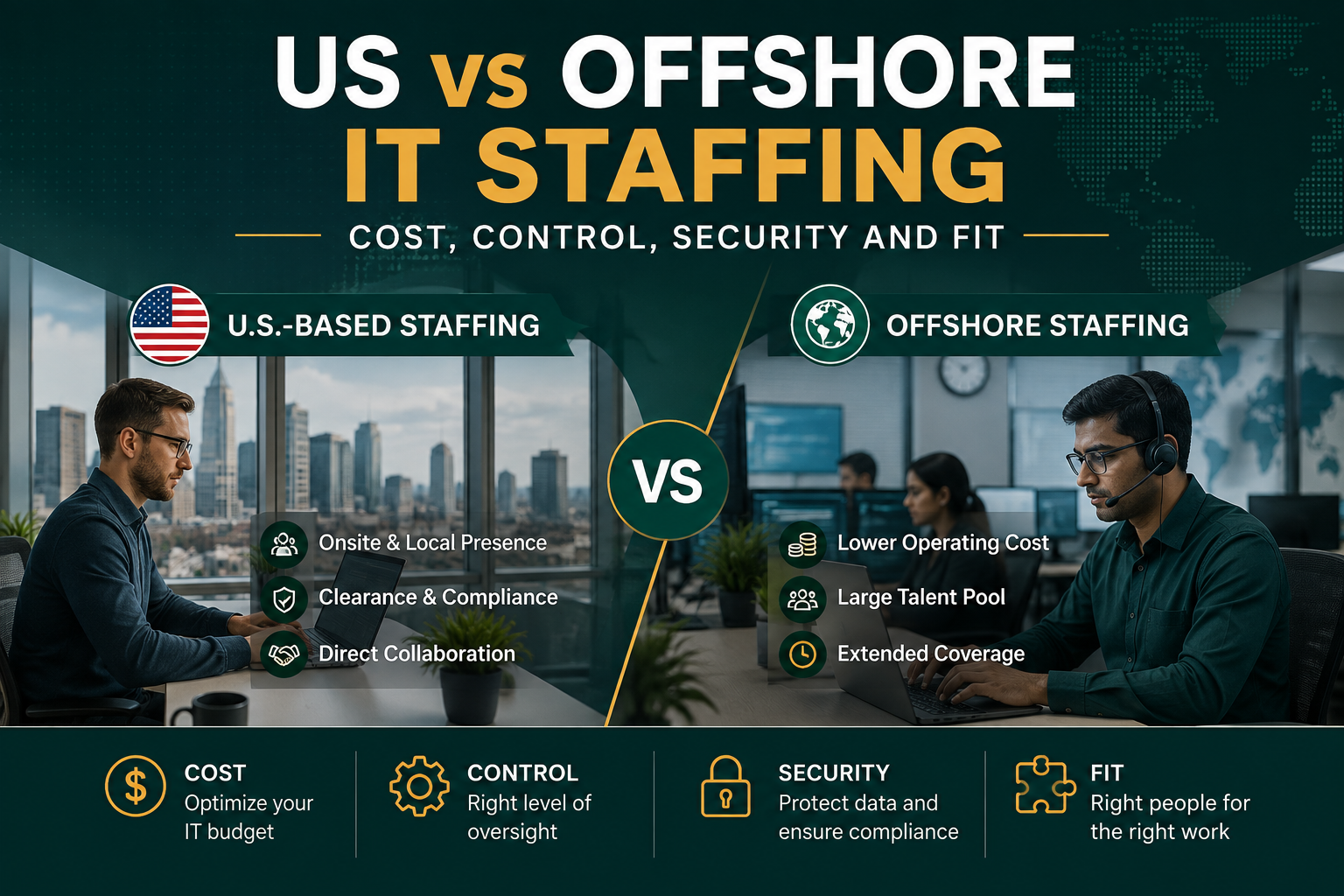
Dedicated Offshore Staffing
For companies that need ongoing technical capacity, dedicated offshore staffing can provide a dedicated remote professional at a predictable monthly cost without building an overseas staffing operation internally.
The right model depends on the role, location, urgency, duration and technical requirements.
What a technical IT staffing partner should actually do
A staffing firm should add more value than sending resumes.
For specialized technology positions, employers should look for a partner that can:
Understand the technology.
A recruiter does not need to be the engineer, but the staffing process should understand what the role actually requires.
Screen before submitting.
The employer should receive a focused shortlist rather than dozens of loosely matched resumes.
Access specialized talent.
Hard-to-fill IT roles require more than the candidates actively applying to job boards.
Offer multiple engagement models.
Contract, contract-to-hire and direct placement serve different business situations.
Support both US-based and offshore requirements.
Location can be a major factor in cost, availability, compliance and working hours.
Stand behind the placement.
Replacement support matters because a bad technical hire is expensive to restart.
How MSPowerhouse approaches IT Staffing
MSPowerhouse focuses specifically on technical staffing rather than treating IT hiring like generic recruiting.
Its staffing team works across roles including Help Desk and IT Support, Systems Administrators, Microsoft 365 Administrators, Azure and Cloud Engineers, Cybersecurity Professionals, Power BI Developers, Data Engineers, Power Platform Developers, Software Developers, IT Project Managers, Business Analysts, and Solution Architects and Specialists. (mspowerhouse.com)
The distinction is in how candidates are evaluated.
MSPowerhouse says its technical team helps assess whether candidates can actually perform the work rather than relying only on resume matching. The company provides US-based talent for onsite, hybrid and remote roles, as well as dedicated offshore talent for organizations looking for additional technical capacity. (mspowerhouse.com)
Its staffing models include:
Contract Staffing
Contract-to-Hire
Direct Placement
Dedicated Offshore Staffing
The current IT Staffing offering also includes no upfront staffing fee, fixed monthly cost, replacement support, US-based and offshore talent, and a 5–7 day shortlist goal, with actual timelines varying by role specialization, compensation, location, clearance requirements and market availability. (mspowerhouse.com)
The process is straightforward: define the role and requirements, source candidates, screen them, receive a focused shortlist, interview the candidates you want to evaluate, and choose the person who fits the role. (mspowerhouse.com)
IT Staffing
Need to fill a difficult IT role?
If your team is struggling to hire for a specialized IT position, start with the role itself.
Tell MSPowerhouse what you need, and the staffing team can match the requirement against its talent network and provide a vetted shortlist.
Contract staffing. Contract-to-hire. Direct placement.
Choose the model that fits the role and the business.