
Contract, contract-to-hire and direct hire are not three prices for the same thing. They are three different risk transfers. Pick by the shape of the work and the classification rules that apply, not by which one looks cheapest this quarter.
The three models, side by side
| Contract | Contract-to-hire | Direct hire |
|---|---|---|
| Employer of record Staffing agency | Agency, then you | You |
| Typical duration 3 to 12 months, scoped | 3 to 6 months, then convert | Permanent |
| Speed to start Fastest | Fast | Slowest |
| Cost structure Hourly bill rate | Hourly, then conversion fee | One-time placement fee |
| Who carries payroll risk Agency | Agency until conversion | You |
| Best fit Bounded project work | Roles you will keep but cannot yet assess | Core, long-horizon roles |
Match the model to the work
The useful question is not contract or permanent. It is whether the work ends. Three common cases:
A six-month Azure or tenant migration.
Defined end date, senior skills you will not need at that level afterwards. Contract. Pair it with a managed migration engagement if you want outcome accountability rather than hours.
A permanent Microsoft 365 administrator.
Ongoing, high context, expensive to lose. Direct hire, or contract-to-hire if you cannot assess Entra, Intune and Purview depth from an interview. Most hiring managers honestly cannot. One constraint to weigh: strong senior candidates sometimes decline a trial period. If the role is urgent and the candidate market is thin, contract-to-hire can narrow your pool. Offset that risk with a decaying buyout (a conversion fee that decreases the longer the contractor works before converting) — it protects both sides.
A Tier 1 helpdesk ramp.
Volume driven and seasonal. Contract the ramp and convert the top performers, or skip hiring and buy a managed helpdesk, where coverage rather than a person is the unit.
The MSPowerhouse take
The most common mistake we see is a permanent role hired on contract because a headcount freeze made it easier to approve.
It works for two quarters, then the contractor converts somewhere else and takes the institutional knowledge along. Restarting the search typically adds two to three months and 15,000to25,000 in loaded recruiting and ramp cost. If the work has no end date, the engagement should not either.
What the labor market says about speed
In the BLS Job Openings and Labor Turnover Survey for June 2026, quits held at 3.2 million — well below the 2021 and 2022 peak. Passive candidates are harder to move for permanent roles, which puts direct pressure on direct-hire timelines while leaving contract engagements easier to fill quickly.
A note on benchmarks: there is no current government statistic for IT-specific time to fill. The DHI-DFH mean vacancy duration series for the information sector was discontinued after 2018, so any tech-specific time-to-fill number quoted today is a vendor benchmark. Our own commitment is a shortlist goal of 5 to 7 days on a clearly defined role, which is a promise about our process, not a market average.
Classification is not optional
W-2 through an agency versus 1099 direct is a control question.
If you direct how, when and where the work happens, the IRS common-law control test points to employment. Routing the engagement through an agency as employer of record is the clean answer.
The 2024 DOL independent contractor rule is in limbo.
The Wage and Hour Division told investigators on May 1, 2025 not to apply that rule's analysis while it reviews the rule. Currently unenforced is not safe, because private litigation and state tests still apply.
The ACA 30-hour threshold reaches contingent workers.
An employee averaging 30 hours a week or 130 hours a month is full-time for employer shared responsibility purposes (IRS guidance on identifying full-time employees). Long temporary assignments create obligations someone has to carry.
Cost over time, not cost per hour
Contract looks expensive hourly and cheap annually when the work genuinely ends. Direct hire looks cheap hourly and expensive annually when the role turns out not to be permanent. Benefits were 30.1% of total employer compensation costs for private industry workers in the BLS ECEC release. Model 12 and 24 months including burden before you decide.
A worked example:
A contract systems administrator at 85perhourbilledfor6months(1,040hours)costsroughly88,400 fully loaded. A direct-hire systems administrator at 96,800salaryplus30125,800 per year — plus recruiting fees, ramp time and severance risk if the role changes. If the work genuinely ends at month six, contract saves roughly $37,000. If it does not end and you are re-engaging at month seven, you have paid a premium for continuity risk you could have avoided.
Decision checklist
Work has a defined end date → contract.
Skill is rare and only needed at peak intensity → contract.
Role is core and you can assess it at interview → direct hire.
Core role but hard to assess → contract-to-hire with a decaying buyout (a conversion fee that decreases the longer the contractor works before converting).
The real need is coverage rather than a person → buy a managed service. This is the option most companies skip because it is not on the staffing menu. If the work is ongoing, the hours are predictable and the skill is not unique to your environment, a managed IT engagement transfers more risk at lower cost than any hire.
How MSPowerhouse works
Four models, one partner, and a replacement if the fit is wrong
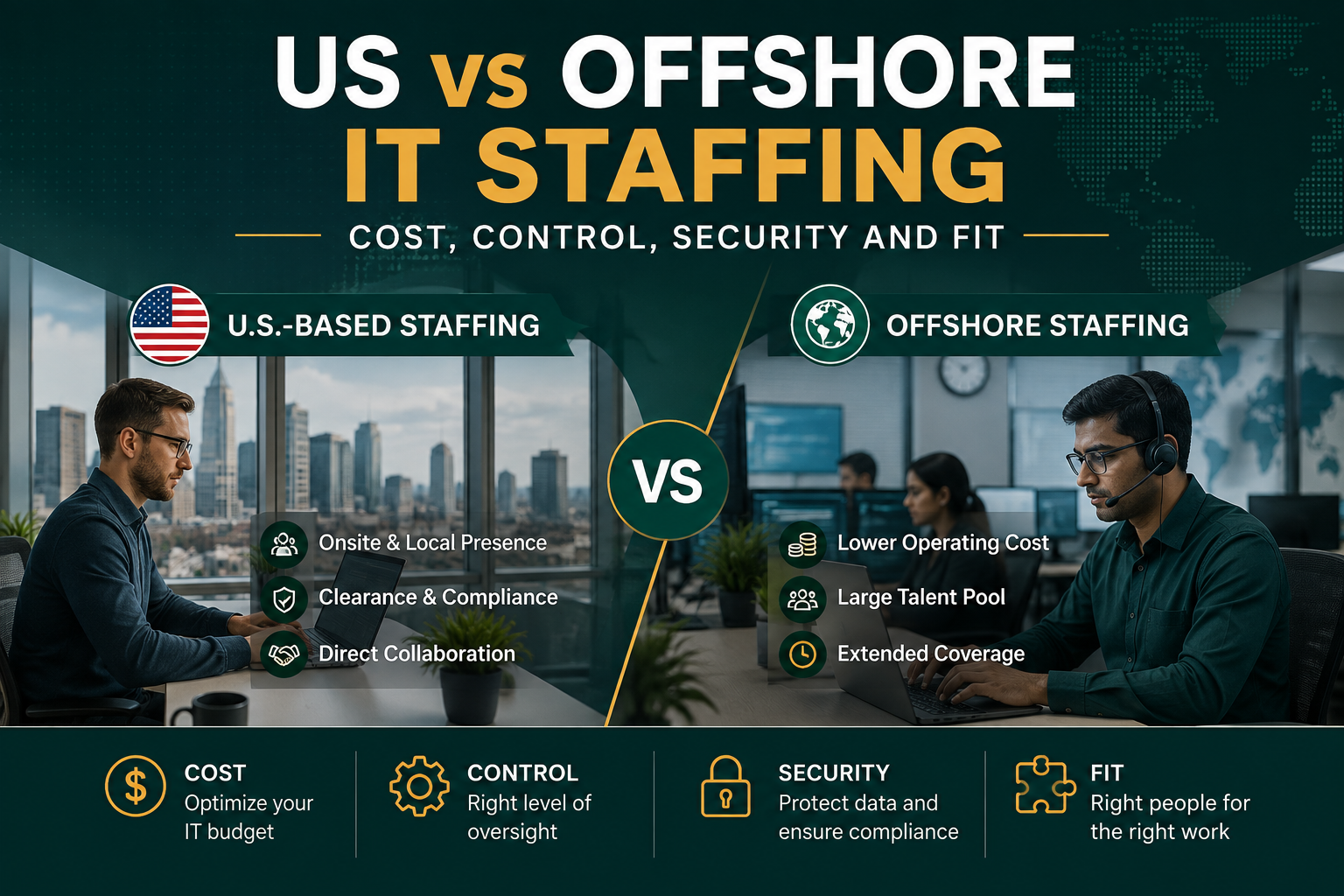
We place contract, contract-to-hire and direct hire, and we run dedicated offshore teams when you need capacity rather than a single headcount. If the person is not right, replacement is included.
- Candidates in 5 to 7 days. That is our shortlist goal on a defined role.
- Technical screening by IT engineers. Our own engineers screen the work, not a keyword match on a resume.
- No upfront fee. You see candidates before you pay anything.
- Month to month. Flexible terms. Cancel when the work ends.
- Replacement included. Wrong fit, we replace the person.
- All process included. Sourcing, screening, payroll and employer of record sit with us.
We run four models: contract, contract-to-hire, direct placement and dedicated offshore teams, with US-based and offshore talent. Full IT support starts at 999permonthandadedicatedITprofessionalstartsat1,499 per month.
We also tell you when hiring is the wrong answer, because we deliver managed IT and the full IT services catalog too. Compare both paths on our staffing page.
Get your candidate shortlist
Tell us the role and how long the work lasts. We will recommend the model, quote it plainly, and send a technically screened shortlist.