
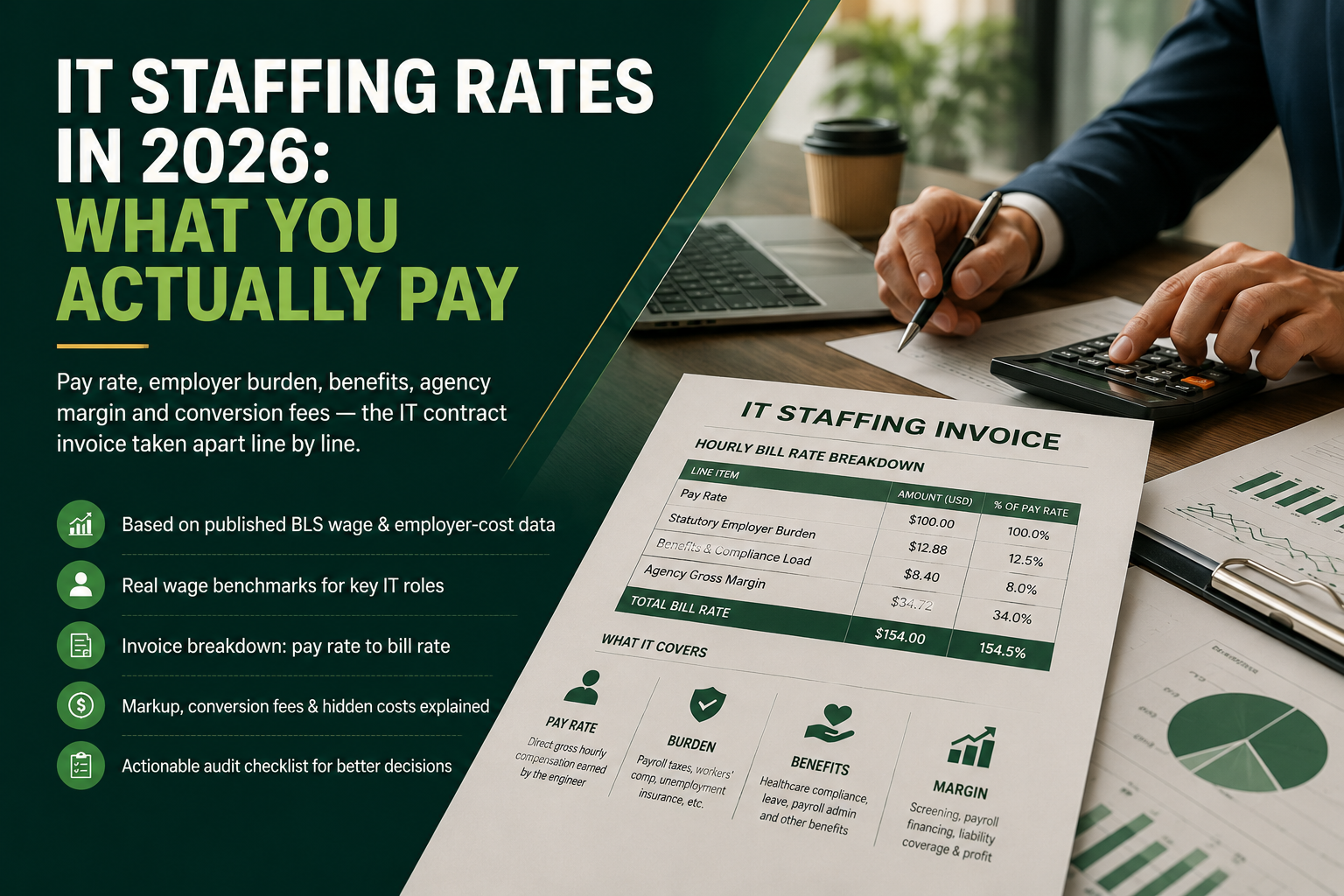
Almost nobody publishes what IT contract labor really costs. You get a bill rate, a smile, and no breakdown. This post takes the invoice apart line by line, using published federal wage and employer-cost data, so you can sanity-check any quote you receive.
Bill rate vs. pay rate
The pay rate is what the contractor earns per hour. The bill rate is what you are invoiced. Everything in between is employer burden plus agency gross margin. Burden is not profit. It is payroll taxes, workers' compensation, unemployment insurance, and any benefits the employer of record carries.
Federal data shows the scale of that burden. In the BLS Employer Costs for Employee Compensation (ECEC) release, total employer compensation costs for private industry workers averaged .60 per hour worked: .60 in wages and salaries (69.9%) and .01 in benefits (30.1%).
For temporary and contract staff, that burden splits into two distinct layers:
Mandatory Statutory Burden (typically 11% to 15% of wages)
Employer FICA (Social Security 6.2% + Medicare 1.45%), Federal Unemployment (FUTA), State Unemployment (SUTA), and Workers' Compensation insurance.
Elective & Compliance Benefits (typically 5% to 15% of wages)
Health coverage required under ACA employer shared responsibility provisions once hours thresholds are met, statutory sick leave, and payroll processing administration.
Start from real wage data
Anchor on published medians before you judge a rate. These are 2024 median pay figures from the BLS Occupational Outlook Handbook. Across all computer and IT occupations the median was ,990, against ,500 for all occupations nationwide.
| Role (BLS Occupation) | 2024 Median Annual Pay | Approx. Hourly (at 2,080 hrs) |
|---|---|---|
| Computer support specialists | ,550 | about .59 |
| Web developers and digital designers | ,380 | about .86 |
| Network and computer systems administrators | ,800 | about .54 |
| Computer programmers | ,670 | about .44 |
| Computer systems analysts | ,790 | about .90 |
| Database administrators and architects | ,100 | about .18 |
| Information security analysts | ,910 | about .05 |
| Computer network architects | ,390 | about .69 |
| Software developers, QA analysts and testers | ,450 | about .20 |
Source: U.S. Bureau of Labor Statistics, Occupational Outlook Handbook. Medians are national. High-cost metropolitan markets (such as Northern Virginia and Washington, D.C.), cleared defense roles, and specialized Microsoft cloud skillsets (Entra, Intune, Defender, Fabric) typically command a 15% to 25% premium above these baselines.
How the invoice is built
Take a mid-level Microsoft 365 and Azure administrator at a .00 per hour pay rate, placed on a standard W-2 contract through an agency acting as Employer of Record:
| Invoice Line Item | Amount per Hour | % of Pay Rate | What It Actually Covers |
|---|---|---|---|
| Pay rate | .00 | 100.0% | Direct gross hourly compensation earned by the engineer |
| Statutory employer burden | .88 | 12.5% | Employer FICA (7.65%), FUTA, state unemployment (SUTA), and Workers' Comp |
| Benefits & compliance load | .40 | 8.0% | ACA healthcare compliance allocation, mandatory state leave, payroll administration |
| Agency gross margin | .72 | 34.0% | Technical screening by engineers, cash-flow payroll financing, liability coverage, profit |
| Total Bill Rate | .00 | 154.5% | Total hourly invoice amount to client (54.5% total markup) |
A bill rate that looks high next to the pay rate is not automatic gouging. Mandatory employer burden and compliance costs account for .28/hr before the agency earns a single cent of operating margin.
The only objective way to judge a quote is to ask for the exact split. Any staffing vendor that refuses to disclose pay rate, burden, and margin separately is asking you to buy a black box.
The MSPowerhouse take
Ask three agencies to quote the same role at the exact same pay rate, then compare their margin lines rather than their headline bill rates.
Comparing bill rates without a pay-rate anchor rewards whoever is quietly underpaying the engineer — and underpaid contractors routinely quit mid-project when a market-rate offer arrives.
About "industry standard markup" numbers
Plenty of blog posts quote a definitive "industry standard markup" for IT contract labor (often asserting 40% to 70%). There is no primary, publicly citable government source for a fixed markup standard: not the BLS, not the Department of Labor, nor a public release from Staffing Industry Analysts (SIA). The numbers circulating online are vendor benchmarks repeated until they sound official.
What is documented is the market's commercial condition. The SIA US Staffing Industry Forecast projects modest 1% growth in 2026 to .2 billion, reflecting a competitive market where agency gross margins are under constant pressure. In practice, competitive IT staffing markups typically range between 35% and 60% over pay rate (representing a 20% to 30% gross margin on the bill rate). If an agency quotes an bill rate on a pay rate — a 142% markup — you are subsidizing excessive overhead, not engineering quality.
Conversion fees, and how to neutralize them
On contract-to-hire, agencies charge either a lump-sum conversion fee when you transition the contractor onto your direct payroll, or a decaying buyout schedule where the conversion fee decreases with every billed hour worked until reaching zero (typically after 720 to 1,040 billed hours / 4 to 6 months).
The decaying buyout structure is strictly better for you. It prices the agency's placement risk into hours you have already paid for, and eliminates the financial penalty for hiring a proven performer. Rule of thumb: negotiate the exact conversion schedule into the master services agreement before timesheet one, never when you are ready to make the offer.
The costs that never reach the invoice
Overtime treatment, background checks and clearances, equipment provisioning, non-billable ramp time, and co-employment exposure all carry hard financial consequences. Build two clear guardrails into every agreement:
Overtime billing pass-through: Overtime should be billed at the same multiplier the contractor is paid (e.g., 1.5x pay rate = 1.5x bill rate), without inflated margin multipliers.
Employer of Record (EOR) certification: The agency must confirm in writing that it acts as the legal W-2 Employer of Record, carrying full workers' compensation, unemployment, and tax liabilities.
On classification: the Department of Labor's Wage and Hour Division issued guidance on May 1, 2025 directing investigators not to apply the 2024 independent contractor rule while under review. However, state-level audits and private litigation continue unabated. If engaging 1099 talent directly, the primary legal benchmark remains the IRS common-law control test. Misclassifying core IT staff is the most expensive mistake in contingent workforce management.
A five-question rate audit for your next IT quote
What is the engineer's exact pay rate, and what are statutory burden and agency margin on top of it?
Is your firm the legal W-2 Employer of Record carrying full workers' comp and state unemployment?
How is overtime billed, and does the markup multiplier remain identical to standard hours?
What is the contract-to-hire buyout schedule, and does the conversion fee decay to zero after 720–1,040 hours?
What is the replacement guarantee if the contractor leaves or is mismatched in the first 30 days?
Not sure if you need a contract hire or a service outcome? If your need is round-the-clock coverage, ticket throughput, or ongoing infrastructure management, buying a Managed IT or Helpdesk service engagement often delivers stronger SLA protection at a lower total monthly cost than staffing individual headcount.
How MSPowerhouse works
Fee transparency, technical screening by engineers, and zero upfront fees
We answer all five rate audit questions in writing on every placement. Our terms ensure you only pay for proven results:
Shortlist goal in 5 to 7 days: Rapid delivery on clearly defined Microsoft 365, Azure, security, and infrastructure roles.
Technical screening by IT engineers: Active Microsoft engineers evaluate candidates on real tenant workflows, not keyword recruiters.
No upfront fee: Review technical shortlists before incurring any commercial obligation.
Month to month flexibility: Scale capacity up or down as project milestones dictate.
Replacement support included: If a placement is not the right technical or cultural fit, we replace the candidate without restarting the fee clock.
Full process included: Sourcing, technical vetting, payroll funding, and Employer of Record compliance sit entirely with us.
We provide four flexible hiring models: contract, contract-to-hire, direct hire placement, and dedicated offshore teams. Full IT support starts at /month and dedicated IT staffing starts at ,499/month. Explore our delivery framework on our IT staffing page and review real client outcomes in our case studies.
Get your candidate shortlist
Tell us the role and the pay rate you have in mind. You will receive a technically screened shortlist, an open rate breakdown, and zero upfront fee.