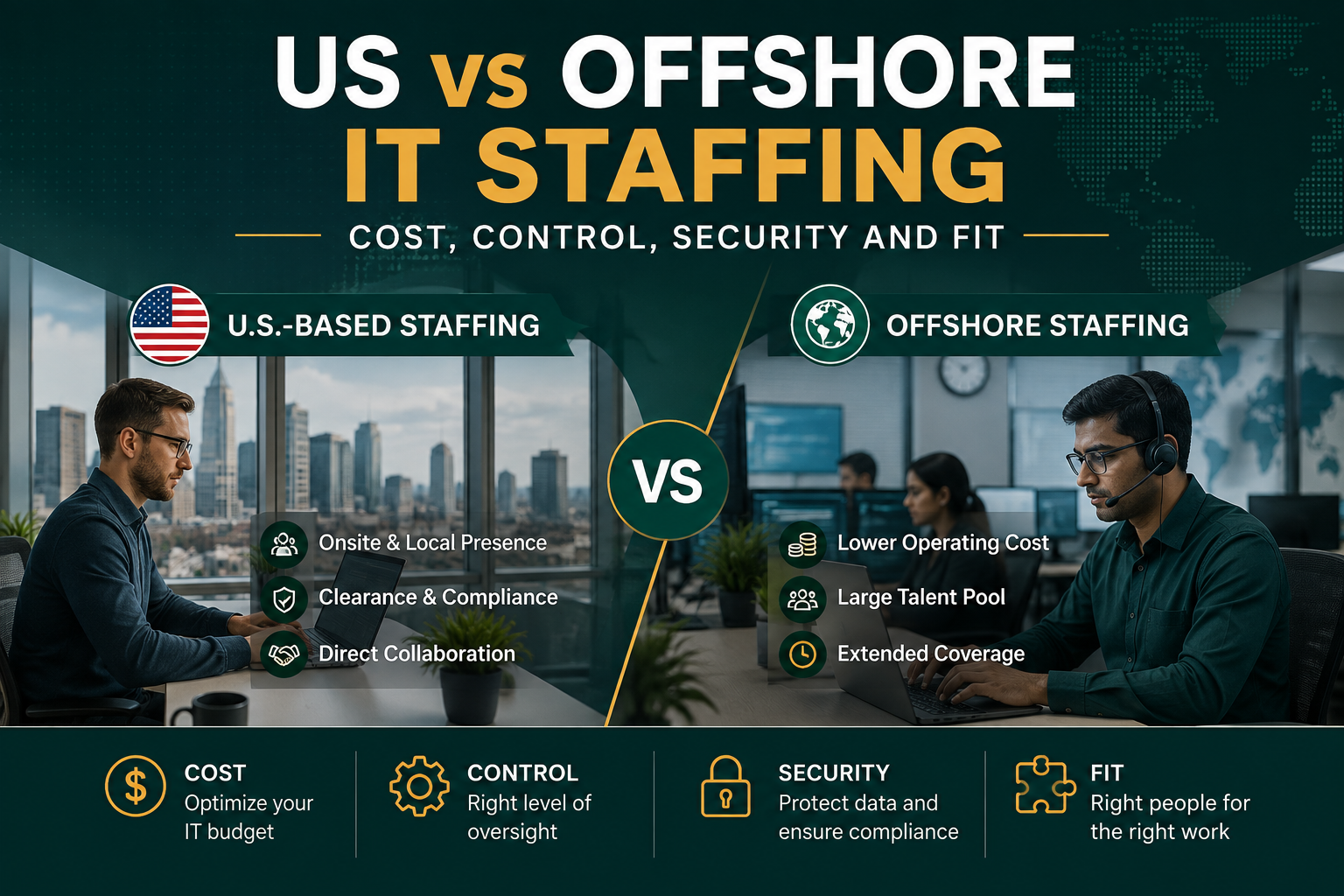
U.S.-based and offshore IT staffing solve different problems.
A company that needs a cleared engineer onsite in Northern Virginia should not choose offshore staffing simply because the monthly rate looks attractive. A company that needs a dedicated Microsoft 365 administrator for routine remote administration should not assume it must recruit a local full-time employee.
The best staffing model follows the work.
The right comparison is not simply U.S. vs. offshore. It is which operating model best fits the role, requirements, security environment and economics?
The Short Version
| Requirement | U.S.-Based Staffing | Offshore Staffing |
|---|---|---|
| Onsite work | Strong fit | Usually not |
| Security clearance | Strong fit where required | Generally not |
| U.S. citizenship requirement | Can accommodate where applicable | Generally not |
| ITAR/export-controlled work | Potential fit, subject to requirements | May be restricted |
| Lowest monthly staffing cost | Higher | Lower starting price |
| Remote administration | Yes | Yes |
| U.S. business-hour coverage | Standard | Can be arranged |
| Dedicated ongoing capacity | Yes | Yes |
| Local customer interaction | Strong fit | Role dependent |
| Extended-hours coverage | Possible | Strong fit |
| Physical data-center work | Strong fit | Usually not |
| Executive-facing local leadership | Strong fit | Role dependent |
This table is a starting point, not a universal rule. Contract terms, security requirements, role seniority and the actual operating model can change the answer.
When U.S.-Based Staffing Wins
U.S.-based talent is usually the stronger choice when the person needs to be physically present, operate in a location-sensitive environment or work under requirements that restrict where the work can be performed.
- Physical onsite support
- Customer or executive interaction
- Frequent travel
- Physical data-center work
- Security-clearance requirements
- U.S. citizenship requirements
- ITAR-controlled work
- Certain government or contractual environments
Location can be a genuine business or contractual requirement, not merely a preference.
For contract-to-hire and direct placement, a U.S.-based staffing model can also make sense when the long-term expectation is for the professional to become part of the client's internal workforce.
MSPowerhouse currently positions its U.S.-based staffing model for onsite, hybrid and remote roles, including contract, contract-to-hire and direct placement, with U.S.-based IT talent starting at $4,999/month. Actual pricing depends on the position and engagement requirements.
When Offshore Staffing Wins
Offshore staffing becomes attractive when the work is remote by nature, can be governed through appropriate identity, endpoint and access controls, and benefits from predictable dedicated capacity.
Typical fits can include:
- Help desk and technical support
- Microsoft 365 administration
- Cloud administration
- Power BI and reporting
- Data engineering
- Development
- Recurring administrative IT work
- Project execution
- Extended-hours operational support
The value is not only lower labor cost.
A wider talent pool can also give an organization access to technical capacity that may be difficult to find in a single U.S. metro area, particularly when the work does not require physical presence.
MSPowerhouse currently lists dedicated offshore IT staffing starting at $1,499/month for qualifying entry-level and routine administrative roles. Senior, specialized and engineering positions are priced according to experience, technical requirements and schedule.
The important distinction is that these are different staffing models, not simply two prices for the same employee profile.
Compare the Real Cost — Not Just the Salary
A common mistake is comparing an employee's salary with an offshore staffing rate as if the two numbers represent the same thing.
They do not.
A U.S. employee's employer cost can include salary, paid leave, insurance, retirement contributions, legally required benefits, recruiting costs and employment administration.
BLS Employer Costs for Employee Compensation data for March 2026 show that, for private-industry workers, wages and salaries represented 69.9% of employer compensation costs, while benefits represented 30.1%. Average private-industry employer compensation was $46.60 per hour worked, including $32.60 in wages and salaries and $14.01 in benefits.
That does not mean offshore staffing is automatically 30.1% cheaper. BLS data describe the composition of U.S. employer compensation; they do not establish a universal offshore savings percentage.
A better comparison considers the full operating model.
| Cost / Operating Factor | U.S.-Based Staffing | Offshore Staffing |
|---|---|---|
| Base compensation | Higher | Generally lower |
| Benefits structure | Depends on employment model | Provider/model dependent |
| Recruiting | Client or staffing provider | Staffing provider |
| Payroll administration | Client/provider dependent | Typically provider-managed |
| Dedicated capacity | Available | Available |
| Equipment / endpoint | Depends on model | Can be managed through provider |
| U.S. time-zone coverage | Native | Can be scheduled |
| Onsite capability | Yes | Usually not |
| Conversion to direct hire | Contract dependent | Contract dependent |
| Replacement process | Contract dependent | Provider/contract dependent |
The correct question is therefore not:
“Which person costs less?”
It is:
“What does it cost to obtain, manage and maintain the required IT capacity?”
U.S. vs Offshore Staffing Pricing at a Glance
MSPowerhouse currently gives buyers a clear starting-point comparison.
Best suited to roles that need U.S.-based talent, including onsite, hybrid, remote and location-sensitive positions.
Available for qualifying entry-level and routine administrative roles, with pricing varying by technical depth, seniority, schedule and other requirements.
These figures should be viewed as starting points for different operating models, not as equivalent prices for identical roles.
Security Is a Design Question
Geography matters in some regulatory, contractual and operational contexts. But geography by itself does not establish a secure environment.
A strong security model can depend on:
- Identity and authentication controls
- Managed devices
- Least-privilege access
- Multi-factor authentication
- Privileged-access controls
- Monitoring and logging
- Data-loss controls
- Defined download and storage policies
- Structured onboarding and offboarding
That principle aligns with NIST's Zero Trust Architecture, which emphasizes that trust should not be granted simply because a user or system is located inside a particular network or physical environment. Access decisions should instead consider the user, device and requested resource.
At the same time, companies should not treat geography as irrelevant.
Data-location requirements, contractual restrictions, export controls, customer requirements and regulatory obligations can all affect whether offshore access is appropriate.
The practical question is:
What will the professional access, from which environment, under what controls, and under which contractual requirements?
MSPowerhouse's dedicated offshore model is built around a managed staffing environment rather than an unmanaged freelancer model, with technical screening and defined requirements around working hours, equipment and access.
Clearance, Citizenship and ITAR Requirements Change the Answer
Some roles should not be evaluated primarily on labor cost.
If the position requires a U.S. security clearance, U.S. citizenship, ITAR-controlled work, a specific place of performance or other government/customer restrictions, those requirements may determine which staffing model is appropriate.
MSPowerhouse specifically identifies security clearances, U.S. citizenship, ITAR-controlled work, certain government environments, frequent customer travel and physical data-center work as situations where U.S.-based staffing may make more sense.
For government contractors, the contract and specific security requirements should therefore be reviewed before deciding where a role can be performed.
Time Zones Are Less Binary Than They Used to Be
One common assumption is:
U.S. staffing = U.S. hours
Offshore staffing = overnight hours
That is too simplistic.
U.S.-based professionals naturally provide U.S.-time-zone coverage. Offshore resources can also be scheduled around required U.S. business hours when the operating model supports it. MSPowerhouse's offshore intake specifically considers required U.S.-schedule alignment and working hours.
The better question is:
What overlap does the role actually require?
A Microsoft 365 administrator who needs to respond during U.S. business hours can be staffed accordingly. A development team that works asynchronously may have different requirements. A support organization looking for extended coverage may benefit from distributing work across time zones.
Time-zone differences can therefore be either a constraint or an operational advantage.
Compare the Full Operating Model
Before choosing a staffing model, evaluate more than the hourly or monthly rate.
Who owns recruiting and screening?
Is the client responsible for sourcing, interviews and technical validation, or does the staffing provider handle those processes?
Is the professional dedicated?
A dedicated resource is fundamentally different from shared outsourced support.
Who manages the endpoint?
Determine whether the professional uses a client-managed device, provider-managed environment or another approved configuration.
What systems can they access?
Define identity, application, administrative and data access before the engagement begins.
What hours are guaranteed?
Spell out U.S.-hour overlap, support windows and after-hours expectations.
What happens after attrition or poor performance?
Understand replacement procedures, notice periods and transition support before signing.
Can the resource convert to direct hire?
For organizations considering contract-to-hire, review conversion terms and fees up front.
Who manages the engagement?
Distinguish between simply supplying a person and providing an operating model with staffing coordination, technical screening and replacement support.
These questions can materially change the economics of the decision.
A Hybrid Model Is Often Better Than an Ideological Choice
Many organizations do not need to choose one model for every IT function.
A blended structure can be more practical.
For example, a company might use U.S.-based talent for:
- Customer meetings
- Architecture decisions
- Security-sensitive work
- Leadership
- Onsite support
And use offshore capacity for:
- Monitoring
- Documentation
- Ticket queues
- Microsoft 365 administration
- Reporting
- Routine cloud operations
- Project execution
This can be especially useful for MSPs and lean internal IT departments that need additional technical capacity without adding several full local payroll positions.
MSPowerhouse's IT staffing model supports U.S.-based and offshore talent under the same broader staffing organization, making a blended approach possible when different parts of the workload have different location, security or scheduling requirements.
The question doesn't have to be:
U.S. or offshore?
It can be:
Which work belongs where?
When Neither Model Is the Right Answer
U.S.-based and offshore staffing are not the answer to every IT problem.
Some organizations need a permanent internal hire because the role is strategic, leadership-heavy or deeply embedded in the business.
Others may need a managed service rather than additional staff because they want an outcome managed for them rather than another person added to the team.
That creates a third question:
Do you need another employee, additional technical capacity or an outcome managed for you?
The answer should determine the engagement model.
How MSPowerhouse Positions the Two Options
MSPowerhouse offers both U.S.-based and dedicated offshore IT staffing through one broader IT staffing organization.
U.S.-based IT talent is positioned for onsite, hybrid, remote and location-sensitive roles, including contract, contract-to-hire and direct placement. The current starting price is $4,999/month.
Dedicated offshore IT talent is positioned for remote technical capacity across areas such as Help Desk, Microsoft 365, cloud, development, Power BI and data engineering. The current starting price is $1,499/month for qualifying entry-level and routine administrative roles.
The objective is not to push every role offshore.
It is to match the staffing model to the actual requirements of the work.
That might mean U.S.-based staffing.
It might mean offshore staffing.
And for some organizations, the best answer will be a blended team.
Tell us what the person will actually do, where they need to work, what systems they will access and what hours they need to cover.
MSPowerhouse can help you evaluate a U.S.-based, offshore or blended staffing model based on the actual requirements of the role.