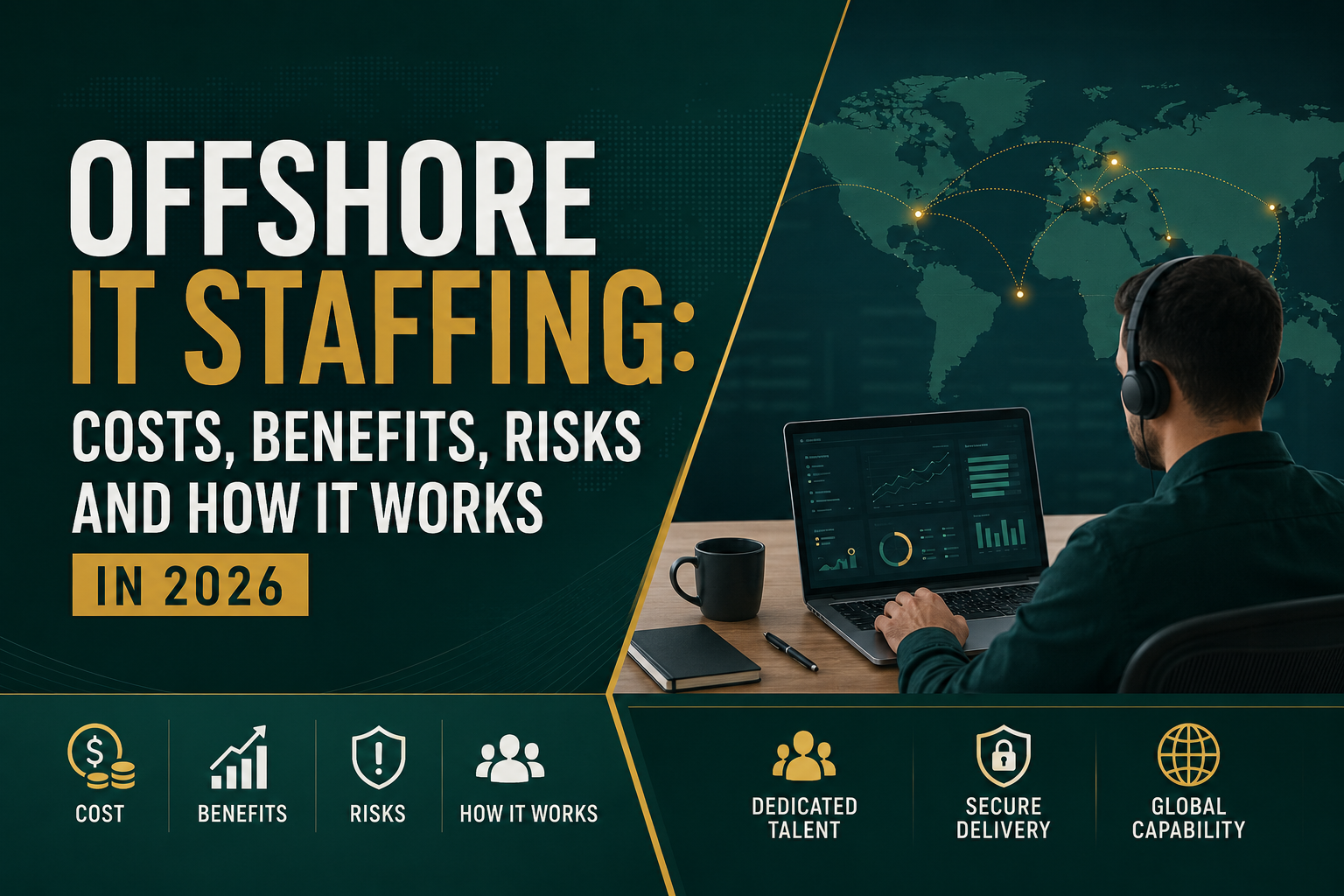
Offshore IT staffing is no longer limited to software-development projects. U.S. companies now use dedicated offshore professionals for help desk, Microsoft 365 administration, cloud operations, data engineering, Power BI, Power Platform, QA and other repeatable technical work. The attraction is obvious: access to a larger talent pool and a lower monthly labor cost. The difficult part is separating a well-run staffing model from low-cost outsourcing that creates more management work than it removes.
The right question is not whether offshore staffing is “good” or “bad.” The useful question is whether a specific role can be performed securely, remotely and with clear accountability. For the right work, offshore staffing can add capacity quickly. For location-sensitive, clearance-based or highly customer-facing roles, U.S.-based staffing may still be the better fit.
What is offshore IT staffing?
Offshore IT staffing places a dedicated technology professional, or sometimes a team, in another country while that professional works as an extension of the client’s internal team. In a true staff-augmentation model, the client keeps control of priorities, systems, workflows and day-to-day direction. The staffing provider handles sourcing, employment logistics and replacement support.
That is different from handing a project to an outsourcing vendor. With outsourcing, the vendor usually owns delivery of a defined output. With staffing, you are buying capacity: a person joins your meetings, works in your tools and follows your operating process.
Which IT roles work well offshore?
Tier 1 and Tier 2 help desk when procedures and escalation paths are documented
Microsoft 365 administration covering Exchange Online, Teams, SharePoint, Intune and Entra ID
Power BI development, reporting and data-model work
Power Platform development and automation
Data engineering and ETL/ELT work
Software development and QA
Routine Azure administration and cloud operations
Monitoring, patching, documentation and after-hours operational coverage
What does offshore IT staffing cost?
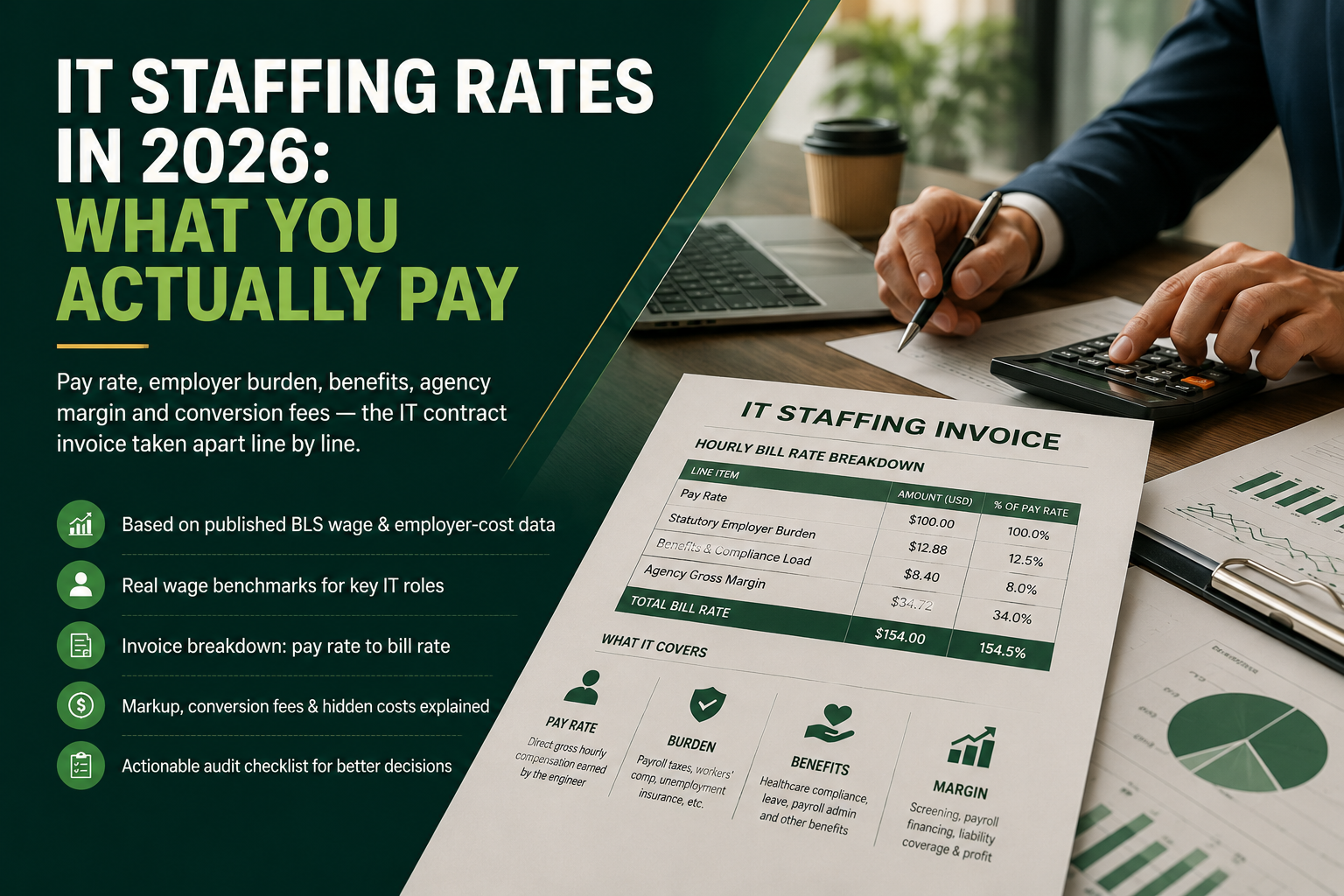
Pricing varies by country, seniority, technical scarcity, working-hour requirements, security requirements and whether the provider includes recruiting, payroll, equipment and replacement support. Instead of comparing a low hourly number to a U.S. salary, compare the full monthly cost of each model.
MSPowerhouse offers dedicated offshore IT talent starting at $1,499 per month for qualifying roles. That starting point is best treated as an entry price, not a universal rate for every engineer. Senior cloud, security, data and architecture roles will normally require a higher budget.
| Cost area | Direct U.S. hire | Traditional contract staffing | Dedicated offshore |
|---|---|---|---|
| Recruiting | Internal or agency cost | Included in bill rate | Included by provider |
| Benefits/payroll burden | Employer responsibility | Agency responsibility | Provider responsibility |
| Replacement risk | Employer restarts search | Depends on agreement | Can be included |
| Monthly predictability | Salary + benefits + overhead | Varies with hours/rate | Often fixed monthly |
| Onsite availability | Yes | Possible | Usually no |
The business case: capacity, not just cheaper labor
The strongest offshore use case is not simply “find the cheapest person.” It is “add a capable person to a bottleneck without waiting months to recruit locally.” A Microsoft 365 team with a backlog of Intune policies, mailbox administration and user lifecycle tasks may not need another $100,000-plus permanent hire. It may need one technically screened administrator who can own a defined queue every day.
The same logic applies to MSPs. An MSP can keep architects and senior engineers close to customers while moving repeatable administration and support work to dedicated team members, improving utilization without forcing every technician into every task.
What can go wrong?
Timezone mismatch: a low-cost resource is not useful if the client needs real-time coverage and the schedule is incompatible.
Weak technical screening: resume matching often fails on Microsoft, cloud and data roles where titles hide very different skill depth.
Security gaps: unmanaged personal devices, shared accounts and excessive privilege can turn a staffing decision into a security incident.
Communication friction: vague ownership and weak written communication create rework.
Hidden replacement churn: a vendor with high attrition can erase savings through repeated onboarding.
Unclear employment model: understand who employs the professional, who handles payroll and what contractual protections apply.
How to make offshore staffing secure
Offshore does not have to mean uncontrolled access. The security model should be based on identity, device, network and data controls rather than geography alone. Use named accounts, MFA, Conditional Access where appropriate, least privilege, managed endpoints or virtual desktops, logging, DLP controls for sensitive data, and a defined offboarding process.
For privileged technical roles, use separate administrative identities, just-in-time or approval-based privilege where possible, and do not allow long-lived shared credentials. The same controls are good practice for employees and U.S. contractors as well.
How to choose a provider
Give the provider a real technical requirement, not only a job title.
Ask who conducts the technical screening and what that screening includes.
Ask for the expected shortlist timeline and what could change it.
Confirm whether the professional is dedicated or shared.
Confirm working hours and overlap with your team.
Review the security and device model before access is granted.
Understand replacement terms, notice period and billing.
Interview the final candidates yourself.
When U.S.-based staffing is the better choice
Choose U.S.-based staffing when the role requires onsite presence, customer-facing travel, active clearances, location-specific regulatory conditions or extremely high real-time collaboration with executives. Offshore staffing is a tool, not a rule. A strong staffing partner should be able to recommend the model that fits the role rather than forcing every requirement into the same delivery model.